
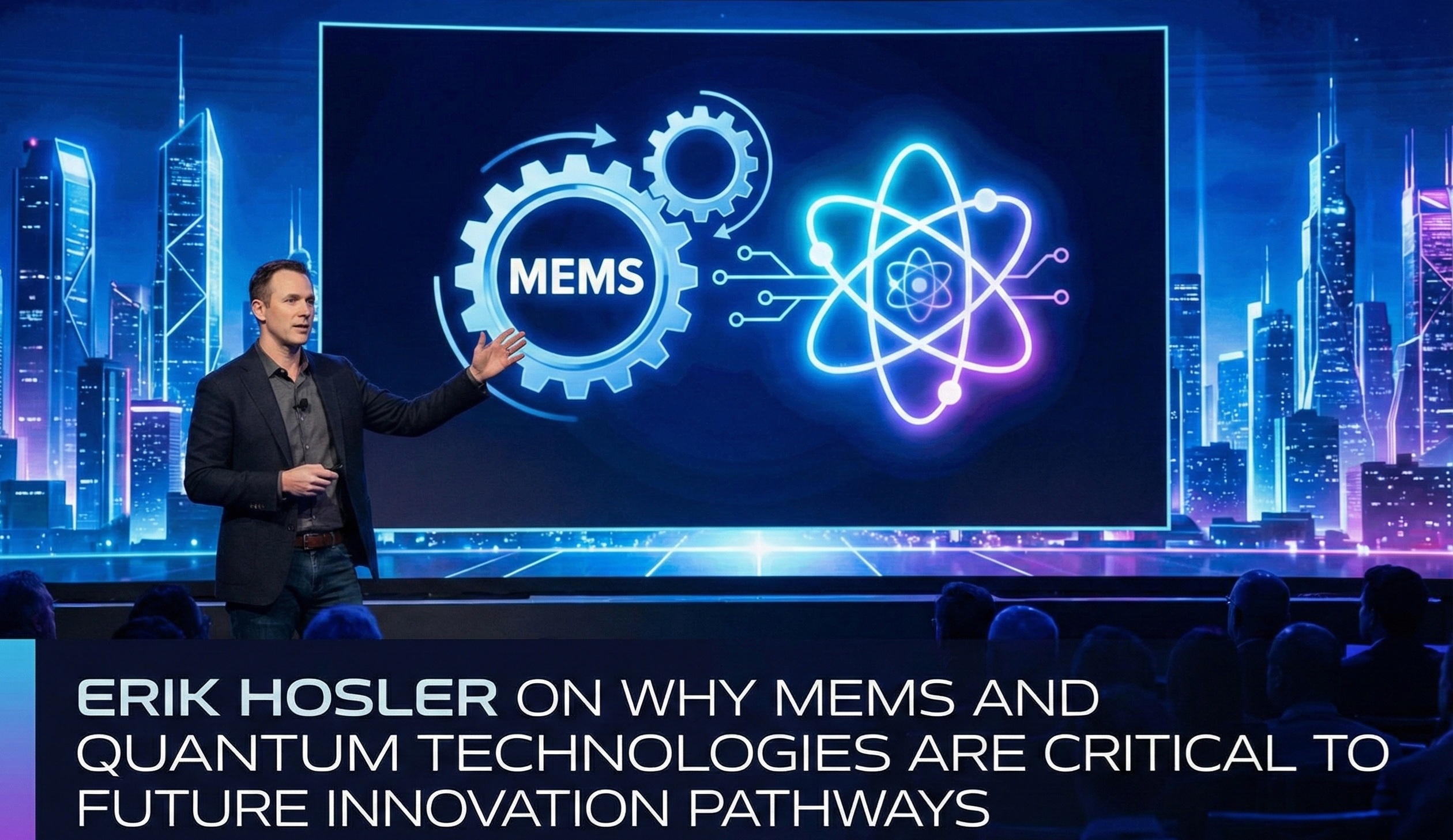
Technology rarely advances in isolation. Every field advances by borrowing insights from others, and progress often emerges where different ideas intersect. The story of modern semiconductor research reflects this pattern perfectly. As engineering moves closer to quantum dimensions, it finds itself revisiting methods and principles that originated in microelectromechanical systems. Erik Hosler, a figure recognized for linking process innovation with material science, acknowledges that these overlapping paths have become essential for sustaining discovery. His perspective illustrates how the frontiers of MEMS and quantum research now meet on the same stage, each informing the other in ways that shape the industry’s future.
This convergence represents more than a shift in technology. It means a profound transformation. It signals a new way of thinking about innovation itself. Instead of treating disciplines as separate, researchers now view them as part of a connected ecosystem. MEMS provides practical insight into fabrication at microscopic scales, while quantum mechanics opens theoretical doors to understanding behavior at the atomic level. Together, they form a continuous dialogue between the tangible and the theoretical. That exchange is becoming the foundation for the next generation of scientific progress.
Shared Foundations, Different Goals
Both MEMS and quantum research deal with precision, yet they approach it from opposite directions. MEMS begins with physical structures, such as tiny switches, sensors, and mirrors, built using techniques borrowed from semiconductor chip manufacturing. Quantum work begins with the invisible, describing particles that follow rules entirely unlike classical mechanics. The first focuses on control, the second on understanding. Yet both depend on tiny scales. Even the slightest variation can change everything.
This shared sensitivity unites the two disciplines. The techniques developed for MEMS fabrication, alignment accuracy, surface conditioning, and defect control are now informing research into quantum devices. Meanwhile, the mathematical frameworks developed in quantum physics are helping MEMS engineers predict how structures behave under conditions that defy intuition.
Learning Through Convergence
The collaboration between MEMS and quantum research has become increasingly visible in laboratories and conferences worldwide. Scientists are beginning to identify where these domains overlap, and the connections are growing stronger each year. The experience gained from decades of MEMS experimentation offers valuable lessons for quantum systems, particularly in manufacturing repeatability and environmental stability.
Quantum research, in turn, introduces new measurement techniques that enhance the analysis of MEMS behavior. Concepts such as superposition and entanglement, once confined to theory, are finding practical parallels in the study of mechanical resonators and micro-scale vibrations. The flow of knowledge between these disciplines accelerates progress in both directions, turning curiosity into capability.
A Broader View of Precision
Precision is no longer just a technical goal but a shared language. MEMS engineers and quantum physicists both strive to control uncertainty, though they do so with different tools. The ability to align and measure microscopic features to near-atomic precision has provided engineers with insight into how quantum principles manifest in physical systems. These observations help build the bridge between design and discovery.
In this environment, research becomes less about strict boundaries and more about relationships. The line separating the mechanical from the quantum begins to blur, giving way to a spectrum of overlapping phenomena. The deeper scientists look, the more they find common ground, proof that progress depends not on separation but on synthesis.
Collaboration as Culture
The success of modern semiconductor research depends increasingly on collaboration. Engineers, physicists, and chemists collaborate to design experiments that transcend traditional boundaries. Shared tools and test environments encourage interaction that would have been impossible a decade ago. The results are more comprehensive experiments and faster cycles of learning.
This cultural shift has turned research gatherings into spaces for idea exchange rather than competition. Discussions, once limited to specific materials or devices, now encompass cross-disciplinary themes. The question is no longer who can reach a milestone first, but how shared insight can move everyone forward. This collaborative mindset enables progress to build momentum collectively, rather than individually.
Expanding the Conversation
Curiosity continues to shape how researchers think about integration. The move toward open discussion and collaborative effort is evident in industry conferences, where the lines between fields are becoming increasingly blurred each year. Panels and papers are increasingly focusing on connections, how MEMS structures can inform quantum sensors or how quantum algorithms can enhance system modeling.
Erik Hosler emphasizes, “Last year, we included MEMS and MOEMS, and we will keep expanding to quantum to make this a place to ask questions … Lots of great things are going on, and something will emerge.” His remark captures the sense of unity and openness now defining the research community. It conveys confidence that progress arises from dialogue and diversity of perspective. It reflects a belief that growth happens naturally when scientists remain curious and receptive to new ideas.
The statement underscores that innovation is not limited by topic but by imagination. By inviting multiple disciplines into the same conversation, researchers enhance their ability to discover unexpected insights. Each field acts as a mirror, reflecting insights that the other might miss.
Shared Tools, Shared Vision
The tools of fabrication have become common ground for both MEMS and quantum research. Advances in lithography, thin-film deposition, and metrology now serve both the semiconductor and the electronics industries. The same instruments that etch microscopic sensors can also define structures capable of trapping quantum particles. This overlap demonstrates that progress in one field amplifies progress in another.
As scientists learn to share both methods and measurement systems, they create a unified framework for advancement. This shared infrastructure accelerates feedback, reduces waste, and enables consistent results. It also nurtures an attitude of collective responsibility, an understanding that every improvement contributes to a larger purpose.
Toward a Shared Future
The growing partnership between MEMS and quantum research offers a glimpse of how science may evolve in the coming decade. As engineers refine their control over materials and processes, they open doors to phenomena that once existed only in theory. The lessons learned from mechanical precision are helping translate quantum potential into practical systems. At the same time, quantum ideas are reshaping how researchers think about control and measurement in classical devices.
In this shared landscape, progress depends less on defining boundaries and more on crossing them. The willingness to see connection where others see contrast has become the industry’s most powerful advantage. The crossroads between MEMS and quantum is not just a meeting point, but the beginning of a continuous path toward discovery.

